
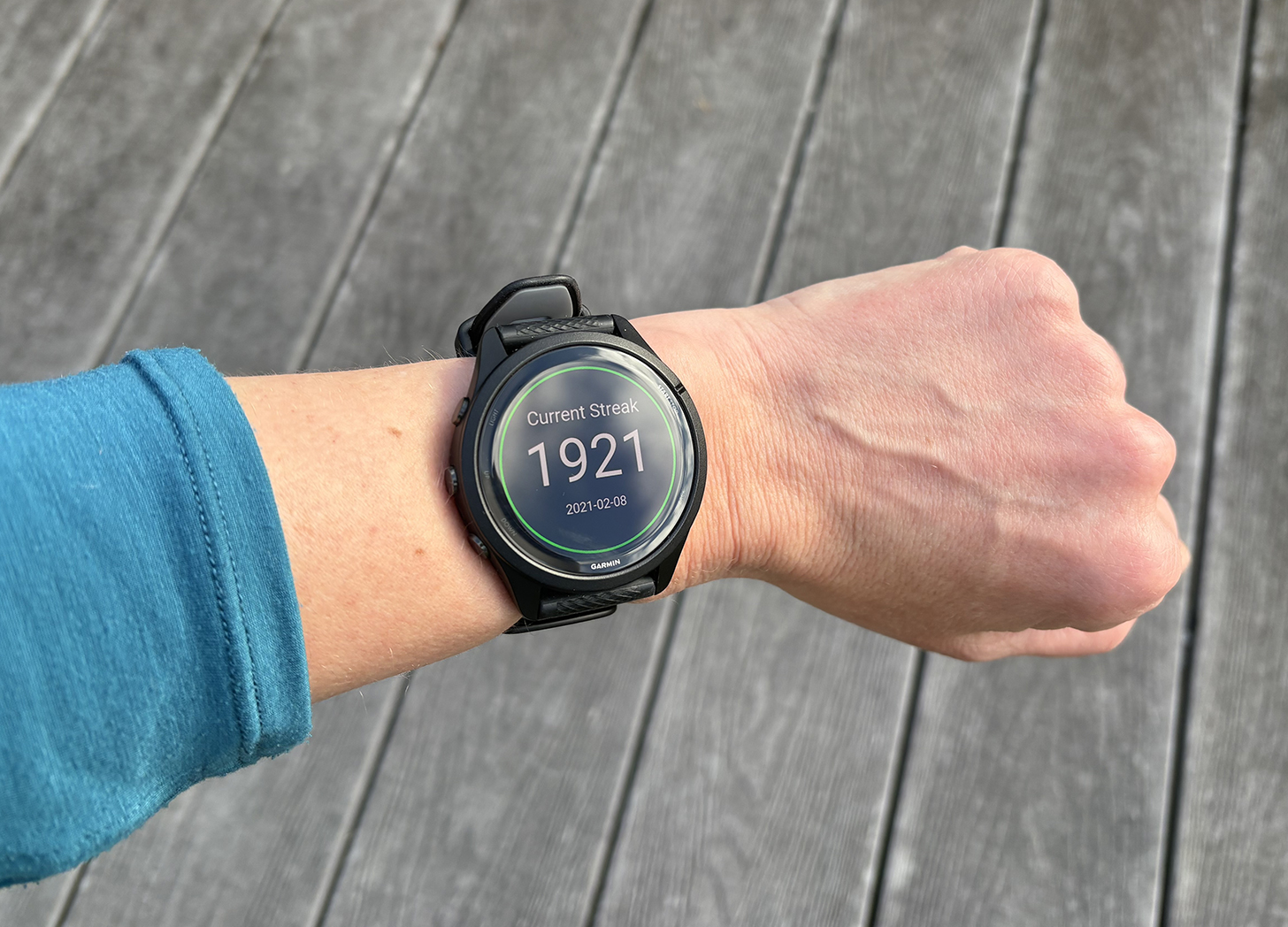
Run streaks often get bad press. I get it. I know why. But streaking changed my life and once you know how to do a run streak, it could change yours too.
What is a run streak?
A run streak is a commitment to run every day without a break. No days off. An official streak is defined as a minimum of a mile. Your streak continues as long as you run at least a mile every day. The longest active streaks have been going for decades.
Before streaking
I was a stop-start, frustrated runner. I’d sign up for a race, do something that resembled training and then, if I was lucky, turn up on race day and complete the distance. Nothing more. Often, I was injured and couldn’t do the race.
Between races, or between injuries, I did very little. I thought I needed something to work towards to keep me motivated. Or maybe I just needed to get some other project or priority or life event out of the way. There was always an excuse disguised as a reason.
I wanted to be a runner. I thought I really wanted to be a runner. I just needed to find a way to make it happen. Then the excuses would kick in, and nothing would happen. I knew I could do it. I’d run two marathons, a handful of halfs, some 10Ks and the odd 5K. Half marathon was my favourite distance.
What changed?
The first thing that changed for me is I lost weight. I’d been running too hard for my weight and kept getting injured. Note that I said my training didn’t accommodate my weight, not that I couldn’t run because I was too heavy. These are not the same thing.
Then I discovered streaking, or, more specifically, the Runner’s World Run Streak Facebook community. Luckily, I came across it just before the annual Thanksgiving to New Years Day streak started.
So, I started a 5K-a-day streak. Why 5K? Well, to me, the effort of getting ready to run a mile felt too much. 5K is around 30-40 minutes which felt like a reasonable amount of exercise.
Everything started to fall into place, I continued to lose weight, I joined CrossFit to introduce strength training into my fitness plan, and I learned how to train properly. Most importantly, I found consistency. I started to ask myself when I would run each day. Before this I’d ask, ‘will I run today?’ The problem with this is that it evokes feelings and emotions. That’s where I used to go wrong. I would ask myself how I was feeling and that started a stream of self-talk that ended up with me ‘running tomorrow’. Only tomorrow never came.
The biggest lesson I learned
Run slow. My first two streaks ended in injury because I didn’t pay attention to what my body was doing. I was training, fairly hard. I wasn’t resting and I was new to streaking. These all compounded into injury at day 90 and then again at day 100.
In 2018 I tried to Run the Year. That is, run 2018 miles. I tried again in 2019. Both times I came up short. Injury was the common factor. When I tried again in 2020, I got to August and still had 1000 miles to go. I had to start tracking my progress, counting down the miles. I ran 6 days a week, with Fridays off. But the daily mileage I needed wasn’t sustainable. It was too long both in distance and the time it took me. I was exhausted, so I started running shorter distances, twice a day. I still had my rest day.
My learning happened from this point. To run twice a day, you must run slowly. You have to moderate your effort and reduce the intensity. There’s no other way, in my experience. This is when I learned to streak, and discovered the highs and lows that came with it. To run slow, to manage and understand my training load.
How to do a run streak
1. Learn to run slowly
This isn’t easy. In fact, it’s very hard, but it’s essential to success. The slower the better, without hurting yourself. A good rule of thumb is to speed up if you feel pain, but you’re at the right pace if you feel fatigued, heavy legs, discomfort.
2. Choose your races carefully
Don’t overload your schedule. You can race, but your recovery won’t be as quick, so you may have to run less races. I run shorter races at the start of the year with a couple of months in between, then I run longer races in the autumn. I don’t go for a PR every time. Sometimes I just run an event for the experience, because I like the look of the course or the location.
3. Recover
Yes, recover. I know that true recovery is complete rest, so you need to find a way to do the minimum possible, keep the maximum gap between runs as much as you can. Get enough sleep. If I run in the evening and need to run again the following morning, I make sure one of the runs is very slow and easy. This makes a good case for running at the same time every day, which makes running consistently easier.
4. Manage your intensity
Don’t bolt together too many hard runs. Remember your body is moving on days you might have previously rested. The cumulative effect of daily runs is important to pay attention to. I use the 10% rule when I’m training, making sure my weekly mileage doesn’t increase by more than 10% and my long run is no more than 10% longer than last week. I have at least one shorter, slow and easy run between harder sessions like intervals and hill repeats.
5. Move more
Yes, this may sound counterintuitive. I ran 5K every morning and then spent the next 12-14 hours sat at my desk, or watching TV, or generally being very sedentary. This is not helpful if you streak. Aim to get out for a walk of 10 minutes or more once or twice a day. In other words, move consistently throughout your day.
Start your run streak
Find a run streak community. I recommend the Runner’s World Run Streak group. Everyone is active year-round but there are two main streaks each year. The Thanksgiving one and Memorial Day to Independence Day. So, if you are looking for a moment to start, 25 May is just around the corner.
The question that changes your mindset
Each morning ask yourself, ‘When will I run today?’ Not, ‘Will I run today?’ When.
Want to create your consistent running habit? Book a call.
