
Continually saying ‘I’ll do it tomorrow’ is exhausting. Right?
It’s a familiar cycle. You tell yourself, ‘This time I’ll do it’. You clear your desk. Make a plan. Your motivation feels like it’s going to deliver. Then life happens. Work is busy. You’re exhausted. You tell yourself, ‘I’ll do it tomorrow’.
That’s the ‘putting it off cycle’. It is followed by the ‘blame cycle’. The one where you blame yourself. Tell yourself you need to try harder. Question your commitment. Look for more willpower.
But that’s not the solution. In fact, the blame cycle feeds the putting it off cycle. Round and round they go. Nothing is achieved.
It’s not a time management problem. It’s a decision problem. Decision fatigue is getting in your way. But that’s good news. There is a solution. Build habits.
The reading pile
I had a growing pile of non-fiction books I wanted to read but just kept looking at. I committed to 5 pages per night and started getting through them. Then I got an Audible subscription. Now I’m reading or listening to material every day that interests me and I keep learning.
The magpie problem
I have lots of ideas, plans I want to write, processes I want to create, content I want to produce. I keep putting them off because I’m not clear on what I want to do or how. I’ve started writing first thing every day when I sit down at my computer. I set a timer for 25 minutes and write. Some days I write an article; some days I collect my thoughts. My goal is to do this every day because on the days I do it, I make more progress. My thinking is clearer and I’m creating the foundations for regular content. I capture content ideas and start drafting what I want to say.
I’m aiming for daily engagement on LinkedIn; another 25-minute work block that is messy. But I’m slowly seeing results and that’s helping me to stick at it. My problem before was my lack of engagement so even when I did spend a bit of time, the results weren’t there. Results create motivation to do more.
Motivation follows action
Motivation follows action, not the other way around. By consistently taking one tiny step, you build momentum. Things start to happen. Progress creates motivation. Think about a project you took ages to start. When you finally did, it started to build, you started to see what it could become, and you kept working on it. You wanted to see how it would build and how it would finish. Action created the motivation to keep going.
Start small. No, smaller than that
The key to building a habit is to start small. Atomic Habits by James Clear and Tiny Habits by BJ Fogg are both built on this principle. But knowing it and trusting it are different things. In my experience, people don’t fully appreciate what small means. They don’t trust that something tiny will get them the results they want.
Last year I ran a 5-day challenge to support people to make one tiny change a day. Some people embraced it. Others bailed on day one because they didn’t have the headspace. But a few approached it with good intentions. Good intentions and big ideas. Setting aside an hour of focused time each day. They’d identified the slot in their day. They’d created their prompt. Everything looked and sounded great. But their intention lasted one day. They went big.
James Clear’s 2-Minute Rule is useful here. If the task takes longer than two minutes, it’s too big. The point is to get started. Make it so small it feels easy. Too easy. Then trust it.
Decision fatigue
Decision fatigue costs you energy. A lot more energy than you realise. Think about all the decisions you make every day. What time to get up, what to wear, what to eat. When you remove these decisions, you give yourself energy to think about other things. I have the same breakfast every day and I have an on-the-go variation. I don’t think about breakfast. Decision made. Energy protected.
The Habit Hack
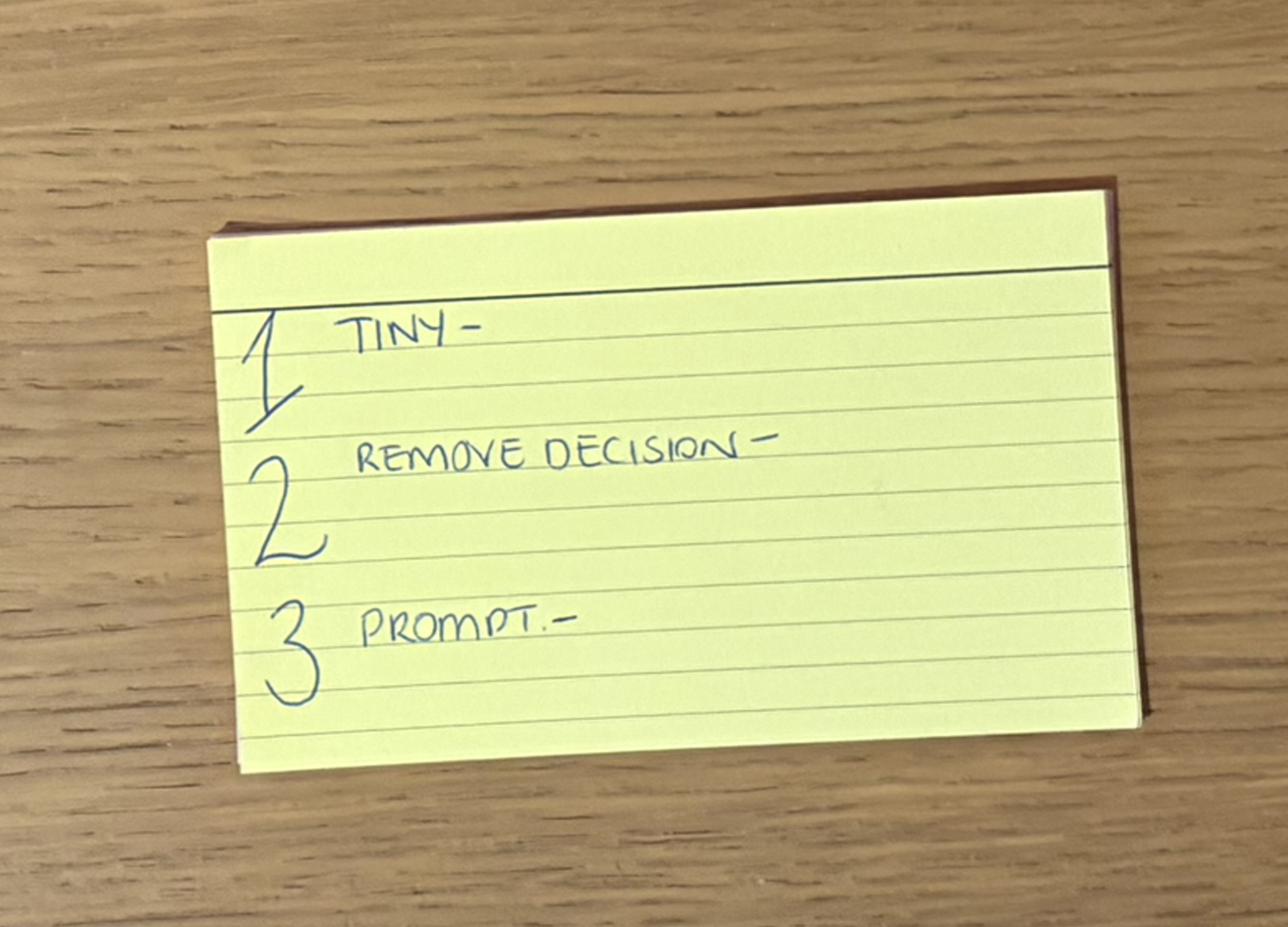
Three steps. That’s it.
1. Make it tiny
What’s the smallest possible version of this task? Use the 2-minute rule. If it takes longer than two minutes, it’s too big. I started with one sentence written at the end of each day. A brief summary of what had happened, something I was feeling, a moment I wanted to remember.
2. Make the decision once
Decide what you will do, when and how you will do it. My one sentence is written last thing at night, after I come upstairs to go to bed. I decided that once. I haven’t decided it since. It just happens.
3. Choose a prompt
A prompt is your trigger. The thing that tells you it’s time. Without it you’re relying on remembering, which means you’re relying on willpower. Which is probably what got you here. Your prompt could be an alarm, an existing habit, a physical cue. Mine is coming upstairs to go to bed. Without a prompt, you will struggle to build a habit.
I didn’t start with 25 minutes of writing every morning. I started with one sentence at night. That habit is what got me here.
Start somewhere
Nothing is perfect. You will have days where your habit feels like magic and days where you question its usefulness. That’s normal.
The Two-Day Rule helps here. Never skip two days in a row. Before I finally managed to lose weight, I was terrible for getting halfway through the week, eating something I ‘shouldn’t’ and then writing off the rest of the week. This usually meant some kind of unhealthy binge at the weekend, ready to start again on Monday.
Now I understand that the binge made Monday harder. My body was still working through everything I’d eaten. I felt sluggish. Difficult to start, even although it was Monday and I love Mondays as fresh start days. If I’d known about the Two-Day Rule, I’d have got straight back to it the next day. No binge. No spike. No starting from scratch.
One bad day doesn’t break a habit. Two in a row might.
Tomorrow doesn’t have to stay tomorrow. Pick one thing you keep putting off. Make it tiny. Make the decision once. Set your prompt. Do it now.
